
If you’re planning to work in Australia, this question comes up early – and it’s not always easy to answer:
Should you go for a temporary visa first, or aim directly for a permanent one?
It sounds simple on paper: one is short-term but the other isn’t. But once you start looking into work visas in Australia, the difference starts to affect everything – where you can work, how secure your job is, and how easily you can plan.
We have seen people choose quickly just to get moving, and then realise later that switching paths isn’t as straightforward as they expected. So it’s worth slowing down here and getting this part right.
Australia doesn’t issue work visas randomly. There’s a clear intent behind each category.
Temporary visas exist because businesses sometimes need people now, not in six months. So the system allows employers to bring in skilled workers for a defined period.
Permanent visas serve a different purpose. They’re meant for people who are likely to stay, contribute consistently, and settle into the workforce.
Both are work visa categories, but they’re solving different problems. That’s why comparing them purely on “duration” misses the bigger picture.
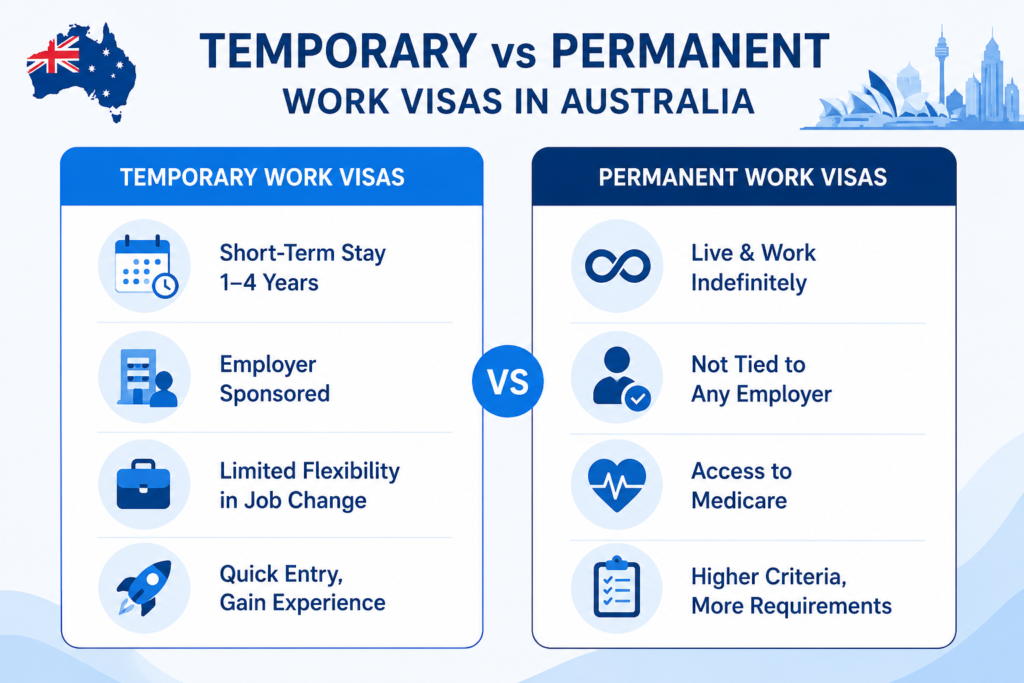
A temporary work visa lets you enter the job market relatively quickly. For many people, it’s the first real step into Australia.
Typical options include:
Most of these are valid for one to four years.
Now, here’s the part that often gets overlooked: you’re sometimes tied to the employer who sponsored you. That means if the job changes, your visa situation might need to change as well.
That’s not necessarily a problem – but it does reduce flexibility.
The upside? For someone trying to gain local experience or test the market, this works out to be a practical starting point.
Permanent visas are different – not just in duration, but in expectations.
Common options:
Once granted, you can stay indefinitely. You’re not tied to any employer and you can change roles, move cities, or even switch industries.
You also gain access to Medicare, which is a major shift from relying on private arrangements.
But getting there isn’t simple. The criteria are tighter – skills, experience, English scores, and often age limits all come into play.
Below is the real difference:
This is usually where the difference becomes real.
If you are on a temporary visa, your employer has a certain level of control over your situation. The Department of Home Affairs states that 482/494 visa holders who stop working, generally have 180 days to find a new sponsor, apply for another visa or depart Australia. Visa conditions can change, so you should check the Home Affairs website for current requirements or speak to a Registered Migration Agent for advice on your situation.
With permanent residency, that dependency disappears.
You can accept a better employment offer or can relocate. You can also step away from a role without worrying about visa consequences.
For someone thinking beyond the first job, that freedom matters.
Yes – but it’s not automatic.
A common pathway is:
Some people also move through state nomination routes.
But here’s where expectations need to be realistic: not every temporary visa leads to permanent residency.
And even when it does, you still need to meet all the requirements.
So while starting temporarily can work, it helps to have a longer-term plan from the beginning.
Temporary visas are generally easier to manage:
Permanent visas are more detailed:
It’s not just more paperwork – it’s closer scrutiny.
Short-term, temporary visas do the job.
Long term, the gap widens.
Temporary visa holders usually depend on private healthcare and have limited access to public support.
Permanent residents get access to Medicare and a more stable setup overall.
It’s not something you notice immediately, but over time it could make a difference depending on your long term goals.
It depends on where you stand.
If you’re:
Temporary visas are a practical choice.
If you:
Then, permanent residency is the stronger option.
Some people go straight for it. Others build towards it. Both approaches can work – if planned properly.
At Kritin Global, we have seen a lot of cases where applicants fail to have a concrete action plan. But we always suggest that the focus should be on getting the direction right before anything gets submitted.
Some applicants clearly qualify for permanent pathways. Others benefit from starting with a temporary visa and building from there. The key is understanding which route fits your situation – not just what seems easier at the moment.
Support usually covers eligibility checks, information collation, and coordination with the Registered Migration Agents for pathway advice and documentation.
The difference between temporary and permanent work visas isn’t just about time – it affects how you work, how you move between jobs, and how stable your situation is in Australia. Temporary visas help you get started, while permanent visas give you long-term control and security.
There’s no single correct choice, but there is a right choice for your situation. Taking the time to think it through now can save you from having to change direction later.
Still not sure what options suit you the best? We offer an eligibility check to assess your situation. For migration advice, we work with Registered Migration Agents.
Yes, but only certain visa types allow it, and you must meet all eligibility requirements at that stage.
Temporary visas are usually processed faster than permanent ones.
No, only specific visa pathways provide a route to permanent residency.
Obligations vary by visa subclass. If you hold a Subclass 482 or 494, your next steps depend on your circumstances. Refer to the Department of Home Affairs website or consult a Registered Migration Agent for guidance.
This information is general in nature. It does not constitute migration advice as visa conditions can change anytime. For advice specific to your situation, consider consulting a registered migration agent or checking the Department of Home Affairs website.


