
The 494 Visa and 482 Visa are two popular employment-related work visas available in Australia; however, they serve two distinct long-term goals. A lot of applicants confuse them, because both allow skilled workers to work for a sponsoring employer; however, the route to permanent residence, the eligibility requirements, and the work location differ significantly.
This guide explains the key differences between the 494 and 482 visas. It also explains eligibility requirements, regional obligations, processing times, and future migration pathways.
If you know the way each visa works and how each visa operates, you can determine which one simplifies plans for work and family situations, as well as your permanent residency strategy, before committing to an employer-sponsored nomination.
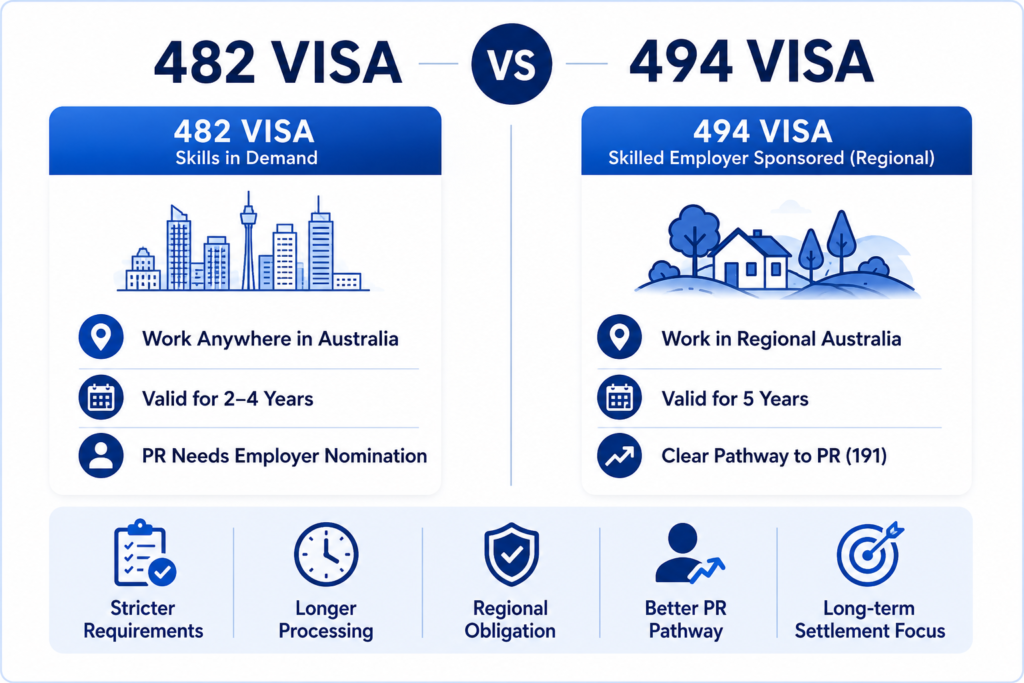
The 482 visa allows Australian businesses to employ foreign workers in areas where local talent isn’t readily available. It’s intended to address labour shortages rather than a direct migration pathway.
The most significant characteristics are:
This visa is designed to meet the immediate demand required in Australia and not permanent settlement.
The 494 visa to Australia was introduced to attract skilled workers to regional Australia.
It balances the need for labour with the objectives for population distribution.
The most important characteristics are:
This visa is more focused on long-term migration and settlement.
482 Visa
494 Visa
This is the main deciding factor.
494 visa
482 visa
The 494 visa is a path to permanent residency through policy design, whereas the 482 visa will lead to PR only if the employment conditions remain in place.
The requirements for a 494 visa are stricter because it leads to permanent residency. Applicants must :
These regulations aim to support long-term regional settlement.
The requirements for the 482 visa offer greater flexibility and focus on immediate employment needs.
The most common requirements for applicants are:
Processing times for the 494 visa are typically longer due to the PR-linked assessment, including:
Average timeline: a few months, dependent on the occupation and documents completeness.
The 482 visa is usually processed faster because:
In many cases, processing is significantly quicker than for the 494 visa.
Your choice should align with your migration goals and circumstances.
Many applicants prefer shorter processing times, however, thinking of long term outcomes is more important.
Important considerations:
A faster visa is not always the quickest path to settlement.
Both visas are valid, but serve different needs. The 482 visa allows immediate employment in cities and offers flexibility, whereas the 494 visa for Australia is designed to facilitate well-planned migration and permanent residency planning. The best option depends on your priorities: temporary job access or settlement security.
Knowing your eligibility for regional commitments, eligibility requirements, and residency options can save you from costly visa changes later. Applicants must evaluate their migration plans that align with their individual circumstances.
If you want personalised guidance based on your occupation, age, and residency goals, Kritin Global can help you determine the most practical pathway before you commit to a visa pathway through an employer.
Yes, provided you have the necessary qualifications, experience for a visa under 494 and an employer nomination form for regional employers.
It’s not a guarantee; however, it does offer the possibility of a PR plan after meeting the financial and residence requirements.
Parents and spouses may be included in the visa application process.
The 494 visa typically offers more secure permanent residence outcomes than employer-dependent routes.
This information is general in nature. It does not constitute migration advice as visa conditions can change anytime. For advice specific to your situation, consider consulting a registered migration agent or checking the Department of Home Affairs website.


