
Here’s what nobody tells you upfront: the agent fee is usually the smallest part of what you’ll spend.
That surprises people. They come in having done their research, seen a professional fee quoted somewhere, and built a budget around that one number – not realising that government charges, skills assessments, health checks, police clearances, health insurance, english tests, and translation costs all sit separately on top of it. By the time everything is counted, the professional fee is often less than a third of what you’ll actually spend.
So before you get a quote from anyone, understand what you’re actually budgeting for.
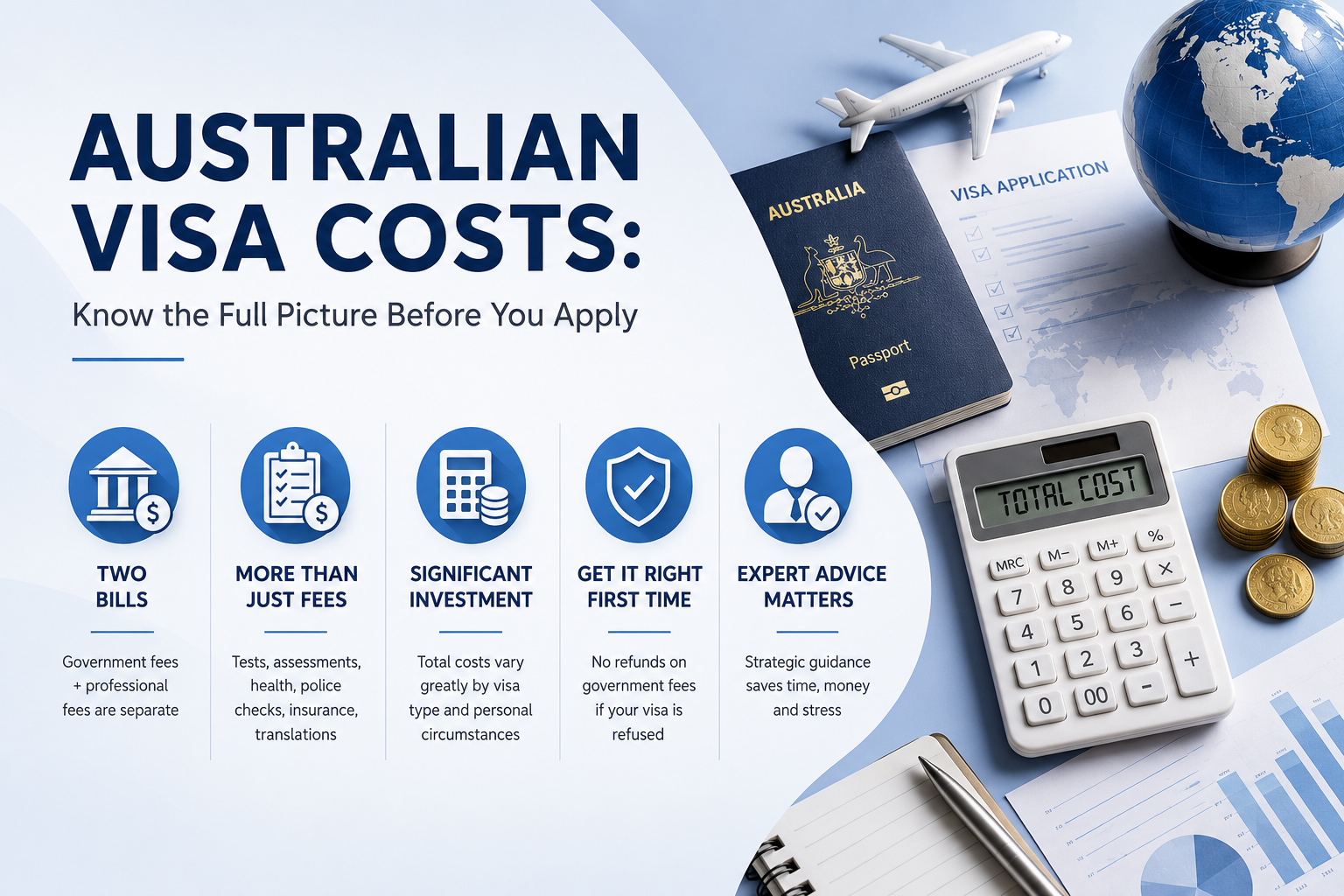
Every Australian visa application involves two completely separate costs that have nothing to do with each other.
Government fees go directly to the Department of Home Affairs. They exist, they’re paid at lodgement, and from 1 July 2026 they went up – roughly 25% across most visa categories. The partner visa jumped from $9,365 to $11,710. The 485 Temporary Graduate more than doubled compared to where it sat at the start of this year. The student visa, skilled visas, employer-sponsored visas — all of them moved. If you were budgeting based on anything published before July 2026, it’s better to plan accordingly.
Professional fees are what you pay for the work. The assessment before anything is lodged. Working out which visa pathway actually fits your situation – because there are often more options than people realise, and the obvious one isn’t always the right one. Preparing the documentation. structuring the application so it holds up, lodging it, following up when it sits in a queue and dealing with whatever comes back. That’s the professional service.
And here’s the part that matters most: government fees don’t come back if something goes wrong. A refused partner visa application doesn’t refund $11,710. A refused skilled visa doesn’t return $6,135. It’s gone. Which is why what your agent does before lodgement isn’t just a service – it’s what protects the much larger sum sitting underneath it.
Primary applicant only. A couple applying for a skilled visa together with two children can clear $13,000 in government fees before a single dollar goes to professional help, assessments, or anything else.
The range on every row is real and the gap between the low and high end reflects something meaningful.
Two applicants can be applying for the exact same visa subclass and represent completely different amounts of work. Clean employment history, qualifications from a recognised institution, everything documented and accounted for – that’s one kind of file. Prior visa refusal on record, overseas qualifications needing formal assessment, health issues that might trigger a waiver process, gaps in work history that need careful explanation – that’s a genuinely different job, and experienced agents price accordingly.
The other thing that moves cost significantly is what a quote actually covers — and understanding this upfront saves a lot of confusion later. Employer-sponsored applications aren’t one application – they’re three. Sponsorship, nomination, and visa, each requiring its own approval before the next can be lodged. A quote covering all three is a completely different engagement to one covering only the visa stage. A good agent will walk you through exactly what’s included from the start and put it in a written service agreement before any fees are accepted – that’s both standard practice and a requirement for every MARA-registered agent in Australia.
Health examinations through an approved panel physician – $350 to $600 per person, for every person named in the application. Police clearances from every country you’ve lived in for 12 months or more. The Australian Federal Police clearance is around $42. International ones vary a lot by country. English language tests — IELTS, PTE, OET – roughly $300 to $400 per sitting, no guarantee of not needing a re-sit.
Skills assessments are the one that consistently catches people. They’re required for a significant range of skilled and employer-sponsored visa applications, and they run $700 to $2,500 depending on your occupation and the assessing body — Engineers Australia, ANMAC for nursing, ACS for IT, TRA for trades. The cost is manageable. The timeline is what changes everything. Some come back in three weeks. Some take four months. We’ve seen assessments come back in the wrong category, requiring resubmission and adding months to the whole process. This is exactly the kind of thing that needs to be factored into the strategy at the start, not discovered as a surprise after the application is already underway.
Document translation for anything not in English needs a certified translator – around $80 to $150 per document depending on length and language. Add it up across a complex file and it’s more than most people expect.
$250 government fee. For a routine application from a low-risk country, most people manage this without professional help and that’s completely fine. Where things get complicated — prior refusals, overstay history, strong ties to the home country that raise questions for a case officer — is where the investment in proper advice pays off. Total cost with professional assistance typically sits between $800 – $2,000.
Government fee $2,500. Professional fees $1,000 to $2,000. Total around $4,500 to $5,500 for most applicants. The part worth knowing: A Student visa decision depends on whether the applicant meets all relevant requirements and provides sufficient supporting evidence. The Genuine Student requirement is an important part of the assessment, but Home Affairs also considers the applicant’s circumstances, immigration history, previous study, employment and economic circumstances, visa compliance and other relevant factors. Strong, consistent evidence across the whole application is therefore important.
$5,750 government fee — worth seeing this clearly that this more than doubled in 2026 compared to prior years, so older budget estimates are significantly off. Professional fees $900 to $2,000. Total $7,300 to $10,000. The 485 has hard timing windows tied to course completion dates. Miss them and it’s not a delay — it’s a different application. These are the kinds of deadlines that need to be understood from the beginning, not the week before they close.
$6,135 government fee per applicant. Then skills assessment, English test if required, health checks for everyone, police clearances across multiple countries, professional fees of $2,500 to $6,000. Single applicant, the realistic total is $10,000 to $15,000. Government visa charges increase when a partner or dependent children are included in a skilled visa application, as additional applicant charges apply. The exact amount depends on the visa subclass, the number and ages of accompanying family members, any applicable concessions and, in some cases, whether a second instalment applies. Use the Department of Home Affairs Visa Pricing Estimator for the current total. Points-tested skilled visas also require careful strategy around when to submit an Expression of Interest and how to position the application — get that wrong and you’re waiting another year for a round that might not come.
Three stages, three separate applications. Sponsorship. Nomination. Visa. Each one approved before the next moves. Government fees are $4,015 for the 482, $6,140 for both the 186 and 494. Professional fees covering all three properly run $3,000 to $7,000. The employer also carries sponsorship and nomination costs, including the Skilling Australians Fund (SAF) levy where applicable. The SAF levy differs by visa pathway and business turnover. For relevant temporary sponsored nominations such as the Skills in Demand visa (Subclass 482), it is generally AUD $1,200 or $1,800 per year or part-year. For relevant permanent or regional employer-sponsored nominations, including applicable Subclass 186 and Subclass 494 nominations, a one-off SAF levy of AUD $3,000 or $5,000 may apply. The exact employer-side costs should always be checked for the specific visa and nomination before lodgement. Total for a primary applicant realistically lands between $9,000 and $20,000.
The $11,710 government fee is paid at lodgement of the temporary stage and covers both stages in one payment — no second charge when you transition to permanent. Professional fees $4,000 to $10,000. Partner applications carry a heavier evidence load than almost anything else. Financial records, communication history, statutory declarations, joint documents, photographs, statements from people in both your lives. It’s not just collecting things and putting them in a folder. It’s understanding what pattern of evidence answers the unspoken questions a case officer is going to have when they read it and making sure the file tells that story clearly. Done properly, total costs for a couple sit between $17,000 and $25,000.
Costs outlined above are just an indication. Your individual circumstances, complexity in the case or specific visa requirements may affect the final figures – speak to a registered migration agent for an accurate assessment.
The applications that go through cleanly and on time aren’t the ones with the most straightforward circumstances. They’re the ones where someone looked at the whole picture before anything was lodged. Caught the occupation code issue before it became a nomination problem. Noticed that the salary was sitting right at the threshold and that the documentation needed to clearly support it. Saw that the skills assessment was going to take three months and built that into the plan from day one.
None of those things are dramatic. They’re just details. But they’re the details that determine whether an application moves or stalls, whether it’s approved or refused. And the cost of fixing a problem after lodgement – or starting over after a refusal – is always higher than the cost of getting it right the first time.
That’s what a good migration agent is actually for.
Some agents offer a free initial conversation but mostly never free tailored advice. Others charge between $150 and $450 for a formal assessment, credited toward the total if you proceed. For anything with real complexity – a prior refusal, unclear eligibility, multiple visa options on the table – pay for the proper assessment first. It costs far less than proceeding down the wrong pathway.
Potentially, where costs relate to Australian employment. Ask your accountant rather than your agent – this depends on your individual circumstances.
Both can legally provide immigration assistance in Australia. MARA-registered agents are regulated by the Office of the Migration Agents Registration Authority. Immigration lawyers are admitted solicitors who can handle migration matters and appear before courts when required. For most standard applications, a registered agent is exactly what the situation calls for. For cases heading toward the Administrative Review Tribunal or judicial review, a lawyer with migration experience is the right call.
The Department of Home Affairs Visa Pricing Estimator at immi.homeaffairs.gov.au. Use it close to when you’re actually lodging – not months earlier. Fees can update anytime and the number that was accurate when you started researching may not be the one that applies when you submit.
This information is general in nature. It does not constitute migration advice as visa conditions can change anytime. For advice specific to your situation, consider consulting a registered migration agent or checking the Department of Home Affairs website.


