
Applying for a partner visa in Australia is not just a documentation process – it is, in many ways, an exercise in proving the authenticity of a personal relationship within a strict legal framework. Many applicants assume that being in a genuine relationship is enough. In practice, however, a successful partner visa application depends on how well that relationship is evidenced, structured, and presented.
It often becomes clear, sometimes only after a refusal or delay, that the system requires more than intent – it demands consistency, clarity, and depth. Whether you are applying for an Australian partner visa as a married or de facto partner, understanding the common challenges early can save both time and money.
At first sight, the procedure could appear easy. Fill out forms, prove your relationship, and then wait for a response. In reality, the evaluation is much more complex.
The migration authorities review relationships based on legal requirements, not on emotional stories. This includes examining shared finances, living arrangements, social recognition of the relationship, and long-term commitment. In the event that you fail to consider any of these components, it could undermine the strength of your Partner Visa case.
It’s easy to understand; however, many applicants don’t realise the level of detail required until they are well into the process.
One of the most generic reasons for partner visa refusals or delays is insufficient evidence.
Candidates are required to show subclass 820/309 evidence across four important elements:
The most common error is to rely on chats or screenshots without supporting financial or household evidence. For instance, couples could share hundreds of photos, but if there is no joint lease or shared bills, this could become an imbalance and a cause for concern regardless of whether the relationship is real.
Consistency is more important than what people realise. Even minor discrepancies in dates, timelines, or personal information could lead to a more thorough investigation.
It’s not uncommon for sponsors and applicants to remember events differently. But if those distinctions are found in official documents or forms, they could compromise credibility.
A solid Australian Partner Visa application must present a concise, well-organised narrative.
This is a requirement for:
Reviewing applications together before submission often helps eliminate inconsistencies.
In the case of couples who are not married, the burden of proof is considerably more demanding. Proving a de facto visa Australia requires demonstration of a relationship for at least 12 months, unless the relationship is registered under a prescribed Australian state or territory law.
This is the reason why many applicants have difficulty.
Sharing accommodation with no formal leases, informal financial arrangements, or cultural differences in cohabitation can create challenges for documentation. It’s more about the relationship and the way it is documented.
In these cases, an organised partner visa application becomes essential to fill in documentation gaps with credible evidence.
Even if people are familiar with the 4 pillars of relationship evidence, the implementation often falls short.
Some applications focus on a particular area while ignoring others. For example:
The department assesses the relationship holistically. A balanced Partner Visa submission should demonstrate the strength of all pillars rather than overcompensating on one.
Relationship statements aren’t only formalities; they are a crucial component of the application.
A vague or generic assertion can be a cause for concern. Statements such as “we are genuine partners” or “we plan to stay together” are not enough to build credibility unless they are accompanied by context.
More powerful statements usually include:
The real proof is in the details. A well-written and concise statement can greatly enhance the validity of an Australian partner visa application.
Beyond the evidence of the relationship, candidates must meet stringent requirements for character and health.
Common issues are:
These conditions are non-negotiable. Even an application for a strong partner visa can be refused if these requirements are not met.
Documentation mistakes are more frequent than we would expect – and they can usually be avoided.
The most common issues are:
It’s important to remember that the department officers don’t always ask for documents that are missing. In some cases, decisions can be made based on the information already provided.
This makes precision and completeness essential from the beginning.
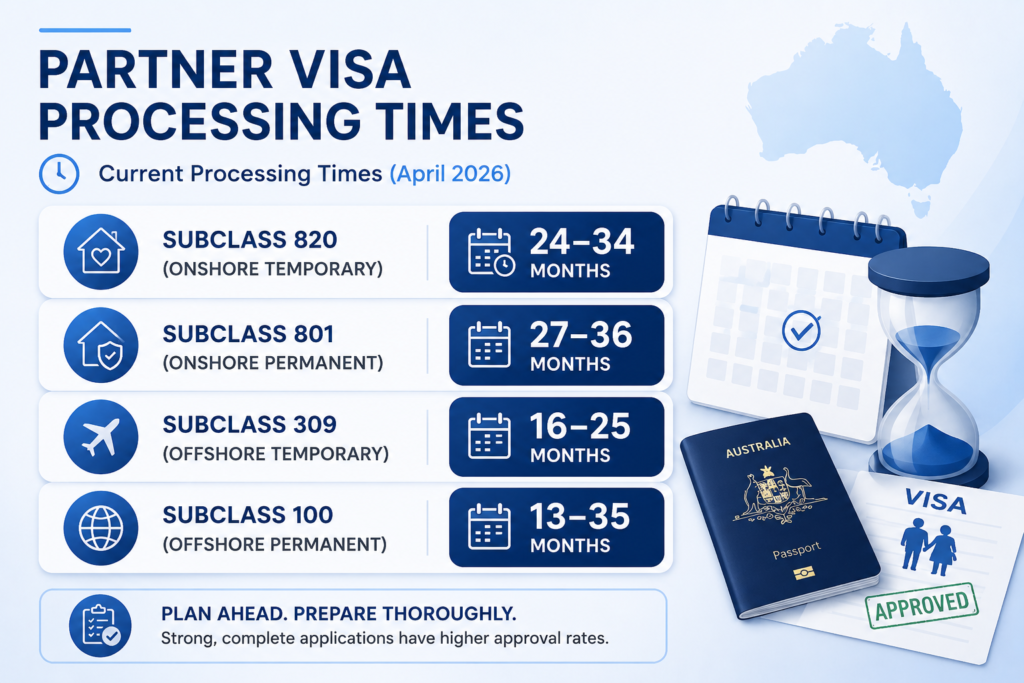
Partner visa applications aren’t fast. The time to process a visa can be months to years, depending on the subclass and the circumstances.
People who rush the process are often guilty of mistakes, such as sending incomplete documents, ignoring important requirements, or failing to read them.
There’s an additional financial aspect; hence, it is important to ensure the application is complete before submitting to avoid costly mistakes.
Processing times may vary depending on the backlog. Always check the official website for exact timeframes. Current processing times as of April 2026 are the following:
It is very important to ensure enough time is taken into consideration when preparing for your partner visa application. 75% partner visa refusals = insufficient evidence. The decision-ready applications tend to have a very high approval rate.
While they’re common, they’re not impossible. A more strategic approach could greatly improve results.
A few practical suggestions are the following:
It may seem complicated; however, this level of effort often makes all the difference.
At Kritin Global, the focus is on creating applications that are not only comprehensive but also credible and well-structured. Each Australian partner visa application is handled with care, ensuring evidence is balanced, documentation is precise, and the overall story aligns with immigration expectations.
From the initial eligibility evaluation through the last submission, the objective is to eliminate confusion and increase clarity, particularly when applicants frequently encounter difficulties. Whether you’re starting the process or looking to fill gaps in your existing partner visa application, organised instructions will make the process much easier to manage.
The process of applying for a partner visa can seem easy initially; however, the reality is different. It’s more complicated than just proving that a relationship exists. It requires transparent, solid, consistent, and properly documented evidence in multiple areas. Inconsistencies, insufficient documentation, and even small omissions can cause major delays.Thus, it is important to carefully organise everything with precision.
If you want to avoid common mistakes and go into the process with confidence, then expert assistance from Kritin Global can help you move forward with confidence and a carefully planned strategy.
An excellent indicator is whether your evidence encompasses all four pillars of the relationship, such as household, financial, social, and commitment, in a fair and balanced manner. If one aspect is deemed weaker than the other, it may indicate that an area needs to be addressed before submission.
A few unintentional minor mistakes might not cause any issue; however, inconsistencies – particularly regarding timeframes or personal information – could raise questions. It is recommended that you review the application thoroughly to ensure all data aligns with the forms and other documents.
Yes, the requirement is generally 12 months of a de facto relationship. If your partnership is registered under a prescribed Australian state or territory law, the 12-month relationship requirement may be waived. For instance, Perth applicants: WA relationship registration bypasses the 12-month rule.
There is no rule about applying too early; however, without complete evidence to support your application, it may increase the risk of refusal or delay. It is generally better to apply when you can clearly demonstrate a stable and continuous relationship.
This information is general in nature. It does not constitute migration advice as visa conditions can change anytime. For advice specific to your situation, consider consulting a registered migration agent or checking the Department of Home Affairs website.


