
The 801 Visa is one of the most important permanent residency pathways for partners of Australian citizens and permanent residents. If you are already in Australia on a temporary partner visa, understanding how the subclass 801 visa works is critical to securing your long-term future.
This guide explains the eligibility, stages, documents, timelines, and common mistakes in clear, practical language so you can move forward with a clear understanding of the process and potential delays.
Subclass 801 visas are the permanent part of Australia’s onshore Partner Visa program. It is usually granted following the issuance of the temporary Partner Visa (Subclass 820) and proof that your relationship is real and ongoing.
In simple terms:
Applications are assessed by the Department of Home Affairs under strict criteria.
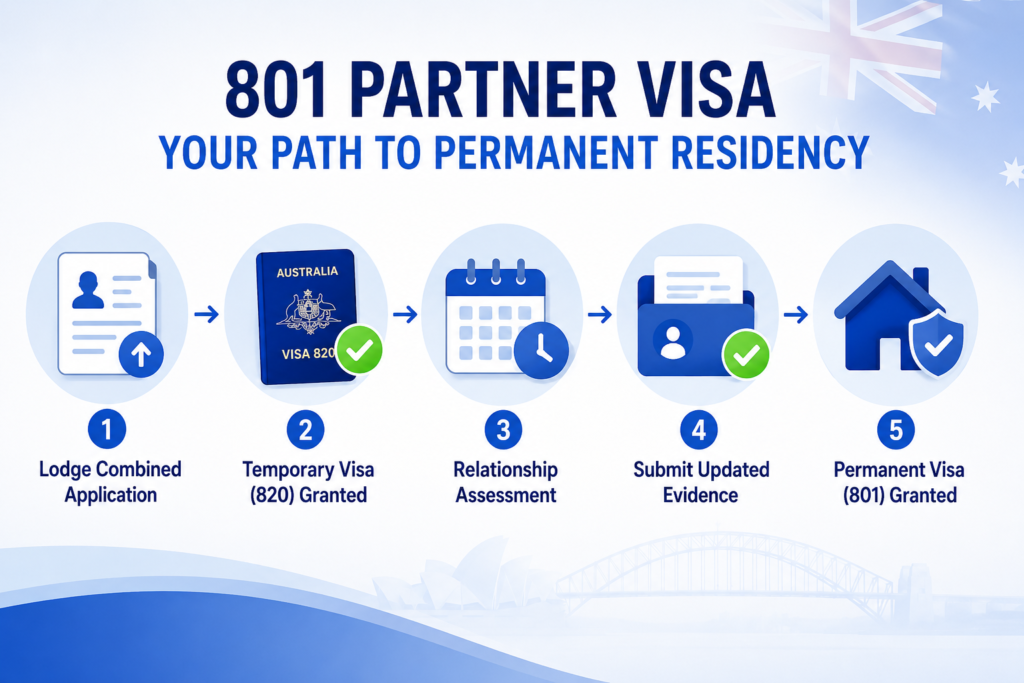
Many applicants ask: What is the subclass 801 visa for Australia, and how does it differ from the visa 820?
The difference lies in its permanent nature.
Subclass 801 visas allow you to:
In contrast to temporary visas, they do not need to be renewed after being granted.
To be eligible for a Visa 801, you need to be a holder of a Subclass 820 visa or have completed a combined visa application.
You may qualify if:
In some long-term relationships, the permanent stage (Subclass 801) may be assessed sooner, without the standard waiting period.
The success of an application for a partner visa depends on the evidence that is provided. Immigration officers evaluate relationships on four main pillars:
The majority of applicants are able to apply for Subclass 820 as well as Subclass 801 visas using ImmiAccount whilst they are living in Australia.
This permits you to remain legally in Australia, while you wait for a permanent assessment.
Typically, the Department determines whether you are eligible for the partner visa 801 within two years of the first date of application.
You might be asked to supply new evidence of the relationship to prove that the relationship continues to be genuine.
Once you have been approved, you’re granted a subclass 801 visa to Australia and you will be granted permanent residence.
Processing times differ based on:
On average:
Inconsistent or incomplete evidence is the primary reason for delays.
Even genuine relationships can be refused if the application is not properly prepared.
Common issues are:
We understand that the subclass 801 visa Australia is not just a legal process – it’s a personal milestone. Our registered migration agents provide strategic guidance at every stage, from assessing relationship eligibility to preparing strong, decision-ready evidence. We help you avoid documentation gaps, maintain consistency across submissions, and respond confidently to Department requests. Whether you are transitioning from a temporary partner visa or preparing updated evidence for permanent assessment, our team ensures your 801 visa application accurately reflects your relationship.
The subclass 801 visa represents security, stability, and a permanent future in Australia with your partner. While the process follows the temporary visa stage, approval depends on clear, consistent evidence and careful preparation at reassessment. Understanding what is expected – and preparing documents early – significantly improves outcomes and reduces delays. Every relationship is unique, and presenting it accurately matters more than simply submitting large volumes of paperwork. Applicants who plan and maintain organised records typically experience smoother processing and fewer requests from the Department.
If you want reassurance that your application reflects your situation properly, professional guidance from our team can help you move forward with confidence.
Yes, if you hold a valid bridging visa with travel rights or your temporary partner visa remains active.
No. You must still meet relationship, health, and character requirements at the time of assessment.
Only in rare cases involving fraud, incorrect information, or serious character concerns.
Yes. Updated relationship evidence is usually required to confirm your relationship is ongoing.
This information is general in nature. It does not constitute migration advice as visa conditions can change anytime. For advice specific to your situation, consider consulting a registered migration agent or checking the Department of Home Affairs website.


